
10 Hidden Costs of Third-Party Delivery Apps for Restaurant Owners
- Jun 15
- 12 min read
Updated: Jul 21
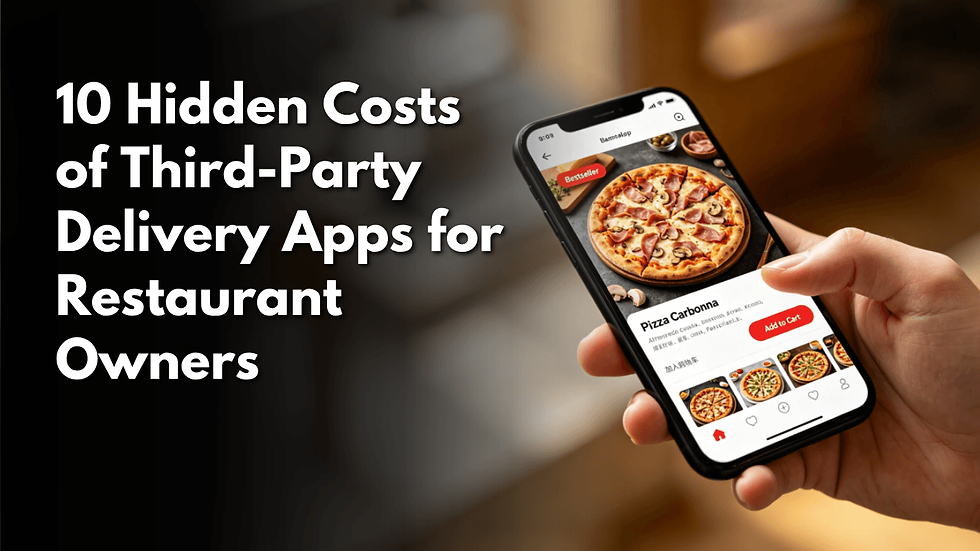
Running a restaurant is one of the most demanding businesses in the world. You manage food costs, labor, rent, equipment, and customer expectations, all at once, every single day. When third-party delivery platforms like DoorDash, Uber Eats, and Grubhub arrived on the scene, many restaurant owners saw them as a lifeline: a fast, easy way to reach more customers without building their own delivery infrastructure.
And at first glance, the pitch sounds reasonable. You get listed on a popular platform, customers find you, and orders come in. Simple.
But for thousands of restaurant owners across the United States, the reality has turned out to be far more complicated and far more expensive. The fees printed in a contract are rarely the whole story. There are layers of costs, both financial and strategic, that quietly compound over time and erode the margins that restaurants can least afford to lose.
This post breaks down the 10 hidden costs of third-party delivery apps that most restaurant owners don't fully account for until it's too late. Whether you are currently on these platforms or considering joining them, understanding what you are actually paying for is the first step toward making decisions that protect your business.
The Difference Between Visible Costs and Hidden Costs
Most restaurant operators are familiar with obvious delivery platform expenses.
These visible costs typically include:
Commission fees
Marketing fees
Processing fees
Delivery charges
Promotional discounts
Because these costs are clearly displayed on invoices, they are relatively easy to measure and manage.
Read more: Top 10 Online Food Ordering & Delivery Platforms for Restaurant Owners (Fees & Delivery Commissions)
Hidden costs are different.
They often affect:
Customer retention
Brand equity
Marketing effectiveness
Profit margins
Operational efficiency
Long-term business valuation
Unlike commission fees, these costs may not appear on financial reports. Yet they can have a greater impact on overall profitability.
The following sections examine the ten hidden costs many restaurants underestimate.
Hidden Cost 1: Commission Fees That Cut Deep
The most visible cost of third-party delivery apps is the commission fee: the percentage of each order that goes directly to the platform before a single dollar reaches you. These rates typically range from 15% to 30% of the order subtotal, depending on the platform, your agreement tier, and the specific services you use.
At first, a 25% commission on a $30 order might not sound alarming. That is $7.50. But apply that rate across every delivery order you process in a month, and the math becomes sobering very quickly.
Monthly Delivery Orders | Average Order Value | 25% Commission | Monthly Cost to Restaurant |
200 orders | $30 | 25% | $1,500 |
500 orders | $35 | 25% | $4,375 |
1,000 orders | $40 | 25% | $10,000 |
For example, if a restaurant sells $10,000 worth of food through a delivery app in a month, a 25% commission means $2,500 goes straight to the app. This reduces the profit margin significantly, especially for restaurants already operating on thin margins.
For restaurants operating on net profit margins that often fall between 3% and 9%, a 25% commission is not a marketing expense — it is a structural threat. In many cases, restaurants are generating gross revenue from delivery orders while actually losing money on each transaction once food costs, labor, packaging, and the platform commission are all factored in.
There is also the issue of tiered pricing. Many platforms offer different commission levels tied to different visibility options. Restaurants that pay lower commissions often find themselves buried in search results behind competitors who pay more. This creates a quiet pressure to upgrade to higher-fee tiers just to maintain the order volume they were already getting — a dynamic that benefits only the platform.
What makes this cost genuinely hidden is the way it interacts with the rest of your Profit and Loss (P&L). Most restaurant operators track delivery revenue as a revenue line. Fewer track platform commissions as the cost of goods sold or as a meaningful reduction to gross margin. The result is financial statements that look healthier on revenue than they truly are in practice.
Hidden Cost 2: Pay-to-Play Visibility
Many restaurant owners assume that once their business is listed on a delivery platform, customers will naturally find them.
The reality is far more competitive.
Third-party delivery apps operate sophisticated ranking systems that determine which restaurants appear first when customers search for food. These rankings are influenced by numerous factors, including customer ratings, order volume, delivery performance, advertising spend, and commission tiers.
As a result, visibility often becomes a pay-to-play environment.
Restaurants that invest in sponsored listings, promotional campaigns, or premium commission programs frequently receive better placement within search results. Meanwhile, independent operators with limited marketing budgets can struggle to maintain visibility even when they offer excellent food and service.
This creates a cycle that many restaurant owners fail to anticipate. When order volume declines, the platform encourages additional advertising spending. To recover visibility, restaurants often increase promotional budgets, which further reduces profitability.
Hidden Cost 3: Promotional Discounts That Train Customers to Wait for Deals
Delivery platforms regularly encourage restaurants to participate in promotions designed to increase order volume.
Examples include:
Percentage-off discounts
Free delivery offers
Buy-one-get-one promotions
First-order incentives
Limited-time campaigns
Participation is typically optional, but restaurants that join these promotions often receive increased visibility and algorithmic advantages.
The immediate result is usually positive. Orders increase and sales volume rises.
The long-term impact is less favorable.
Every discount reduces margin. When a restaurant already pays a 20% to 30% commission, adding another 15% or 20% discount can dramatically reduce profitability.
Even more concerning is the effect on customer behavior.
Repeated promotions can condition customers to wait for discounts before placing an order. Instead of choosing a restaurant because of food quality, brand reputation, or customer experience, purchasing decisions become driven primarily by price.
This creates a customer base that is difficult to retain at full menu pricing.
While promotions can be effective when used strategically, relying on them as a primary growth tactic often leads to shrinking margins and weaker customer loyalty. The restaurant generates more transactions but not necessarily more profit.
Hidden Cost 4: Loss of Customer Data and Direct Relationships
When a customer orders through DoorDash or Uber Eats, who owns that customer relationship?
The honest answer is: the ordering and delivery platform does.
Third-party delivery apps collect the names, email addresses, phone numbers, order histories, and location data of every customer who orders through them. That data is used to send those customers promotions, suggest competitor restaurants, and build increasingly sophisticated profiles that the platforms monetize in ways that have nothing to do with your business.
As the restaurant, you receive the order. You do not receive the customer.
This is a cost that does not appear on any invoice, but it is real. Consider what it means over time:
You cannot send a follow-up email to a first-time delivery customer to invite them back.
You cannot segment your customers by frequency, order size, or neighborhood to craft targeted promotions.
You cannot build a loyalty program that rewards your highest-value delivery customers directly.
You cannot contact your own customers to announce a new menu item, a special event, or a seasonal promotion.
Every restaurant that builds its own ordering system, whether through a branded website, a direct app, or a digital marketing strategy — accumulates customer data that compounds in value over time. That data becomes an asset. It enables smarter marketing, stronger retention, and a direct communication channel that no platform can take away.
In an industry where repeat customers are the backbone of stable revenue, the inability to communicate directly with your delivery customers is not a minor inconvenience. It is a strategic limitation with compounding costs.
Hidden Cost 5: Brand Erosion Through Lost Presentation Control
A restaurant's brand is built through every touchpoint a customer experiences: the quality of the food, the packaging, the way staff interact, the visual identity, the atmosphere. Every one of those elements communicates something about who you are and what kind of experience you deliver.
When an order goes through a third-party platform, you lose control over much of that brand experience. The food leaves your kitchen in your packaging, but from that point forward, the customer's experience is shaped by the platform's app, the platform's driver, the platform's customer service policies, and the platform's review infrastructure.
Here is what that looks like in practice:
Packaging integrity
Delivery drivers are independent contractors working across many restaurants simultaneously. The care taken with your food during transport varies widely. A carefully plated dish or a delicate item may arrive damaged, cold, or incomplete, and the customer's first instinct is to blame the restaurant, not the delivery process.
Rating conflation
Most platforms display restaurant ratings that blend dine-in reviews with delivery reviews without clearly distinguishing between them. A customer who receives a cold order due to a long delivery time may leave a low rating that permanently affects how your restaurant appears to future customers, even though the quality of your food and service was never in question.
Undifferentiated listings
On a third-party platform, your restaurant is one tile in a grid. You appear next to direct competitors, and often next to cheaper alternatives the platform's algorithm is actively promoting. The brand story you have spent years building: your unique concept, your sourcing philosophy, your connection to the community is compressed into a logo, a photo, and a star rating.
Hidden Cost 6: Pricing Limitations That Squeeze Profitability Further
Many restaurant owners attempt to offset delivery commissions by increasing menu prices on third-party platforms.
While this approach may seem logical, it often creates a new set of challenges.
Customers today are highly price-sensitive and increasingly compare menu prices across multiple channels. If a meal costs significantly more on a delivery app than it does on the restaurant's website or in-store menu, customers may perceive the restaurant as overpriced rather than recognizing the impact of platform fees.
Some delivery marketplaces also encourage pricing consistency between channels. While policies vary, restaurants frequently face pressure to maintain competitive pricing even when delivery costs continue to rise.
As a result, operators find themselves trapped between two difficult choices:
Keep prices low and absorb commissions.
Raise prices and risk losing orders.
Neither option is ideal.
The situation becomes even more complicated when promotional discounts are added to the equation. A restaurant may already be sacrificing a substantial percentage of revenue through commissions, only to be encouraged to offer additional discounts to improve visibility and order volume.
Hidden Cost 7: Menu Compression That Limits the Culinary Identity
Not every menu item is suitable for delivery.
Certain dishes depend on presentation, texture, temperature, or freshness to deliver the intended dining experience. Foods that perform exceptionally well in a dining room may lose their appeal after spending 30 or 40 minutes in transit.
To solve this problem, many restaurants simplify their delivery menus and remove items that do not travel well.
While this improves operational consistency, it comes with trade-offs.
A reduced menu often means fewer opportunities to showcase what makes the restaurant unique. Signature dishes may disappear from delivery channels. Premium items may be removed entirely. Chefs and operators may feel pressure to prioritize portability over creativity.
Over time, delivery demand can begin influencing menu development decisions.

Hidden Cost 8: Operational Complexity and Additional Labor Costs
Third-party delivery also leads to operational complexity by managing multiple delivery platforms.
Every incoming delivery order must be integrated into kitchen workflows, staffing plans, inventory management, and customer service processes. During peak periods, delivery orders can compete directly with dine-in guests for kitchen capacity and staff attention.
Additional packaging materials increase costs. Staff members spend time managing tablets, resolving order issues, communicating with drivers, and handling customer complaints. Kitchens may require workflow adjustments to accommodate growing delivery demand.
As order volume increases, these responsibilities often require additional labor hours or new technology solutions.
Operational challenges also affect customer satisfaction. A surge of delivery orders during a busy lunch or dinner service can slow ticket times for dine-in guests. This creates pressure on staff and can impact the overall guest experience.
Unlike commission fees, these costs rarely appear in a single report. They are spread across labor budgets, packaging expenses, and operational inefficiencies.
When restaurants calculate the true cost of delivery, these indirect expenses are frequently overlooked despite having a meaningful impact on profitability.
Hidden Cost 9: Dependency That Weakens Your Long-Term Business Position
When a restaurant's delivery revenue becomes a meaningful portion of total sales, that restaurant has effectively made a business-critical decision to rely on a vendor it does not control. The platform can change its commission structure. It can change its algorithm. It can change its terms of service. It can enter exclusive arrangements with competitors. It can launch its own restaurant concepts — as some already have — and promote them in search results above independent operators.
Any of these changes can materially affect your business overnight, and you have no contractual protection against most of them.
This dependency also creates internal operational patterns that are difficult to unwind. Staff become accustomed to the volume coming through platform tablets. Kitchen workflows are built around delivery demand. Marketing attention shifts away from building direct relationships because the platform is handling "acquisition." The restaurant gradually becomes a fulfillment center for a third-party sales channel rather than an independent business with its own direct customer relationships.
Hidden Cost 10: Balancing the Benefits and Costs
Despite these hidden costs, third-party delivery apps remain a valuable tool for many restaurants. The key is to balance their use with strategies that minimize expenses and protect the brand.
Some practical steps include:
Encouraging customers to order directly through the restaurant’s website or phone.
Offering exclusive deals or loyalty rewards for direct orders.
Carefully monitoring app fees and negotiating better terms when possible.
Investing in packaging and staff training to maintain food quality.
Using customer feedback to improve both delivery and in-house experiences.

Understanding these hidden costs helps restaurant owners make smarter decisions about delivery partnerships. By being aware of the financial and operational impacts, restaurants can better protect their profits and maintain strong customer relationships.
Why Many Restaurants Continue Using Delivery Apps?
Despite these hidden costs, delivery platforms remain valuable for many restaurants.
They offer advantages that can be difficult to replicate independently.
These benefits include:
Large customer reach
Immediate visibility
Operational convenience
Delivery infrastructure
Incremental revenue opportunities
The goal is not necessarily to eliminate third-party delivery apps.
Rather, restaurant owners should understand the complete financial picture when evaluating their role within the business.
The most successful operators typically view delivery marketplaces as one component of a broader growth strategy rather than the foundation of their entire customer acquisition system.
The Real Numbers: What Third-Party Dependency Actually Costs
To put this in concrete terms, consider a mid-volume independent restaurant doing $60,000 in monthly revenue, with 40% of that coming from delivery through third-party platforms: $24,000 per month.
At a blended commission rate of 25%, that restaurant is paying $6,000 per month — or $72,000 per year — in platform commissions alone. That figure does not include the cost of packaging upgrades for delivery, the staff time spent managing multiple platform tablets, or the revenue lost to customer attrition driven by poor delivery experiences.
Cost Category | Monthly Estimate | Annual Estimate |
Platform commissions (25%) | $6,000 | $72,000 |
Incremental packaging for delivery | $400 | $4,800 |
Staff time on platform management | $300 | $3,600 |
Lost repeat customers (estimated) | $800 | $9,600 |
Total estimated cost of dependency | $7,500 | $90,000 |
These numbers are illustrative, but they reflect the range of costs that real restaurant operators have reported when doing a thorough accounting of what third-party platforms actually cost them. For most restaurants, the true cost is substantially higher than the commission line alone.
What Sustainable Restaurant Growth Actually Looks Like
Understanding the hidden costs of third-party delivery apps is not an argument for abandoning delivery altogether. Delivery is a meaningful revenue channel for many restaurant types, and customer demand for it is not going away. The argument is for building delivery as part of a balanced digital strategy — one where direct channels capture a growing share of orders over time.
The restaurants seeing the strongest growth right now share several characteristics:
They show up in local search
When someone types "best tacos near me" or "pizza delivery in [city]," restaurants with optimized Google Business Profiles and strong local SEO rankings appear at the top of results. Those clicks go directly to the restaurant's website or phone number — no platform commission involved.
They have a high-converting website
A professional restaurant website with direct online ordering is one of the highest-ROI investments available to an independent operator. Every order placed through the website is a zero-commission order and a customer relationship the restaurant owns.
They invest in social media
Regular, well-crafted content on Instagram and other social media platforms builds a community of customers who see the restaurant as a brand they are loyal to — not just a listing in an app. That loyalty translates into direct orders, word-of-mouth referrals, and resilience against platform algorithm changes.
They manage their online reputation actively
Reviews on Google, Yelp, and other platforms directly influence where customers choose to spend their money. Restaurants that respond to reviews, solicit feedback, and maintain a strong public reputation earn trust that no paid advertising can replicate.
They diversify their digital presence
Rather than relying on one platform or one channel, the healthiest restaurant businesses spread their digital footprint across multiple owned and managed channels — giving them flexibility and protection against single-point failures.
Building a Restaurant Business You Truly Control
Third-party delivery apps have changed the restaurant industry and will likely remain an important part of the dining landscape for years to come. They provide convenience, reach, and access to customers who may never have discovered your restaurant otherwise.
However, the true cost of these platforms extends beyond commission percentages.
Loss of customer ownership, shrinking margins, weakened brand recognition, limited control over customer experience, and growing dependence on marketplace algorithms can all affect profitability and long-term business value.
Understanding these hidden costs allows restaurant owners to make more informed decisions about where future growth should come from and how much control they want to maintain over their business.
At Prome Digital Growth, we help restaurants build stronger digital foundations through restaurant SEO, local search optimization, Google Business Profile management, delivery marketplace optimization, website growth strategies, and customer acquisition systems designed to support sustainable growth.
If you're evaluating your restaurant's marketing strategy and want to understand how to generate more direct customers while improving long-term profitability, contact our team to learn how we can help your restaurant grow with greater visibility, stronger customer relationships, and more control over your future success.


Comments